
Exploring Daishō-in Temple in Miyajima: Japan's hidden Buddhist Gem

Updated: May 1
Miyajima is full of surprises - two famous shrines, both so different, both equally mesmerising.
On the one hand is the tourist hotspot of Itsukushima Shrine...long vermilion-painted corridors that spell grandeur with the majestic views of the Torii gate that demand instant attention right from the moment you disembark from the ferry on Miyajima; on the other hand, is Daishō-in Temple, a hidden gem, quietly tucked away from the bustle of the touristy glare and yet so enchanting that you thank your stars that you could come so far into the island to see it and did not give it a miss!
Believe it or not, this was the first thought that came to my mind upon visiting Daishō-in.

Established as early as 806 CE, Daishō-in is Miyajima's oldest temple and one of the 3 great temples in Japan.
The temple is believed to be what the Japanese call a 'Power Spot', implying it has miraculous abilities to ward off evil and bring good luck!
Getting to and around Daishō-in Temple
As you exit from the Itsukushima Shrine, walk for about 10 minutes uphill through the quaint town of Miyajima. Follow the road signs along the scenic route.
Daishō-in is located at the foot of Mount Misen across a bridge.

The main gate of the temple is called the Niomon Gate, which is guarded by two fierce-looking statues, called Agyo and Ungyo.
Once you enter, you will be led up a broad staircase of about 200 steps.
In the middle is a wide railing; underneath are small, elongated gold pipes, spinning metal wheels inscribed with Buddhist Sutras. Spinning the pipes gently as you go up the steps is considered very auspicious.
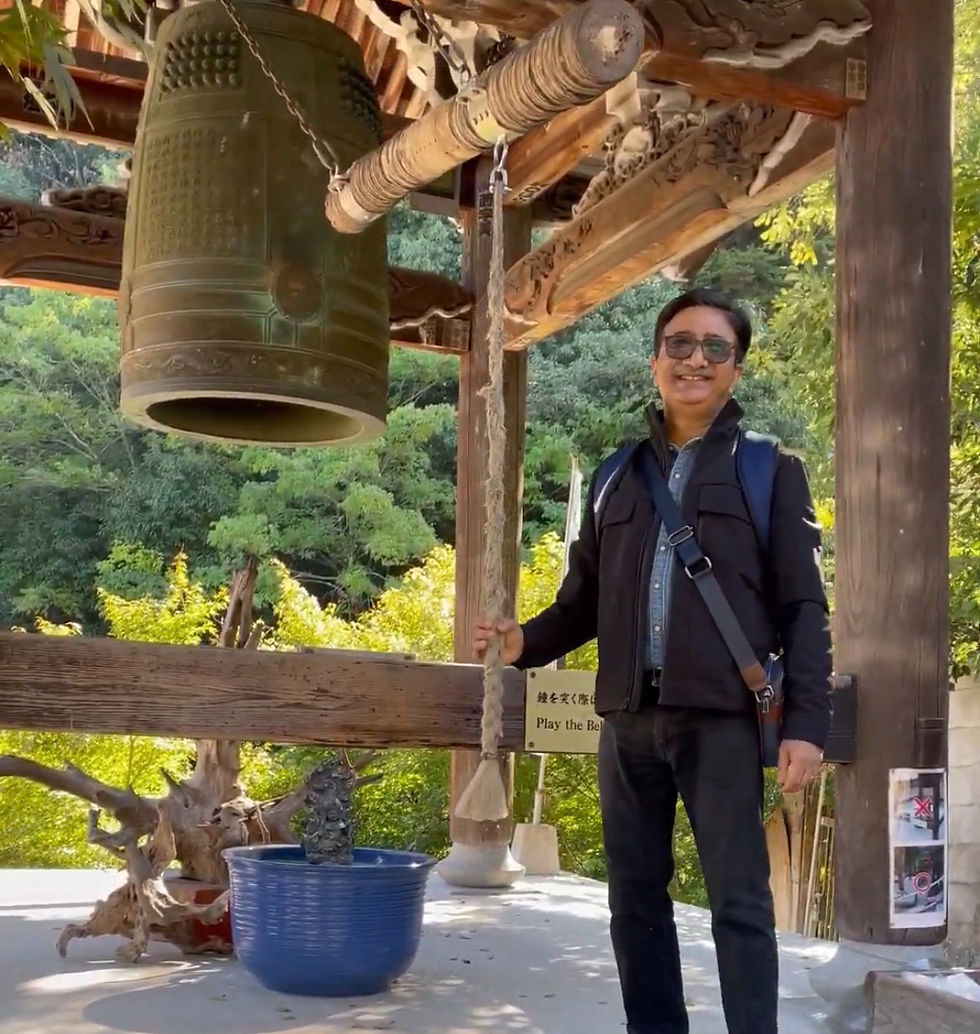
On your left, you will see a massive bell called the Century Bell. Strike the bell with the heavy gong just once and wait to hear its echo piercing the silence of the temple.
Keep walking up the stairs to reach the main courtyard of the temple, which houses the Kannondo Hall.
This splendid hall is a riot of colour with elaborate Mandalas (a colourful geometric design of great symbolic significance in both Buddhism and Hinduism), stunning statues and motifs.

The most eye-catching statue is that of the 11-headed Kannon (considered to be the Bodhisattva of Mercy).
Photography inside the Kannondo Hall is not forbidden, but I did not take a picture of this statue out of respect for the locals who were worshipping there at the time.
In front of the Kannondo Hall is a life-size statue of Binzurusonjya, popularly known as the Touch and Cure Buddha. He is considered to be one of the best disciples of Buddha with miraculous powers to heal anyone who touches this statue on any part of the body that is in pain.
We were tired from all the walking around the island, my legs were hurting, so I touched the knees and legs of this statue. I cannot say for sure that the pain was gone instantly, but it sure felt good!

Another interesting statue that is sure to catch your attention is the statue of Enma Daio, the ruler of hell, as per Japanese belief. He maintains a scroll of all the good and bad deeds of human beings in this lifetime and the past, and rewards or punishes people accordingly.

I found this statue especially intriguing since we have his counterpart in Hinduism too, called Yama, the God of Death and his assistant, called Chitragupt, responsible for maintaining an impartial account of all the good and bad deeds of humans and dealing with them accordingly after they leave their material bodies.
At the rear of the temple is the beautiful Henjokutsu Cave.
Visiting this cave can be a spiritually uplifting experience. It is dimly lit with hundreds of glowing lanterns and 88 Buddhist statues, each representing a temple from the Shikoku Pilgrimage. (https://en.wikipedia.org/wiki/Shikoku_Pilgrimage)
After exploring the temple grounds of Daishō-in, you can take a hiking trail up to the summit of Mount Misen, where more temple halls are located. The hike should take about 2 hours.
We had to skip the hike owing to a lack of time and thereby also skip the chance to see Reikado, Hall of the Spiritual Flame and its famous Kiezu-no-hi, the Eternal Flame, which has been burning for over 1200 years!
This flame is used to light the flame at the Cenotaph in the Hiroshima Peace Memorial Park.
But the real surprise was waiting for us as we headed back when we were treated to this amazing sight...


As you walk back towards the entrance to the temple, a small path on your right, lined with 500 Rakyan, will lead you out towards the Niomon Gate.
Rakyans are disciples of Buddha, each with a unique, distinct expression on their face. Their heads are adorned with small red caps, which are donated by visitors as an offering to protect them from the cold.
This path creates an other-worldly charm that is hard to express in plain words...the calm of the temple grounds with the echo of the bell chiming now and then, and these Rakyans guiding your way out back into the real world!
How to Spend a Day at the Daishō-in Temple Miyajima
The temple is a treasure trove of wonders, one more enchanting than the other. We had allocated a good 2 hours to see it, but upon reaching there, I realised that we should've kept one hour more. If you wish to hike to the summit of Mount Misen, then you will need this extra time.
It is an active temple, so be mindful of your conduct and what you wear. Preferably, cover your knees and shoulders. You will also see a lot of people worshipping and praying. Maintain decorum accordingly.
Wear comfortable shoes. There is a lot of walking involved, plus one needs to remove their shoes at some places in the temple. Moving around the temple grounds can be tough for people with limited mobility.
The temple is free to enter from 8 am to 5 pm on all days.
The temple hosts many festivals throughout the year, when it can get very crowded. Please refer to the official website before your visit
That's Miyajima for you....in the evening, we boarded the JR Line to our next destination...Kyoto. Coming up next!


Comments