
Visiting Hiroshima: A Journey beyond the Horror of History

Updated: May 1
Hiroshima needs no introduction.
On August 6th 1945, the name of this city forever became synonymous with the ultimate devastation that human beings were capable of inflicting, when it became the first city to be the target of the atomic bomb during WWII.
Today, when you visit Hiroshima, what you see is a modern, thriving city that has evolved from its scars and has transformed itself into a symbol of peace.
Every year, on 6th August, the city holds memorial services at the Peace Memorial Park to remember and honour the victims of the atomic genocide.
What You Need to Know Before Visiting Hiroshima
Like most people, we began our trip to Hiroshima as regular tourists, eager to learn more about the history behind the bombing, see the Peace Memorial that we had heard and read so much about in textbooks, take pictures, visit the museum, and see the memorabilia with our own eyes.
Still, as we went along the Genbaku Dome, followed by the Peace Memorial, the Children's Memorial, the Peace Museum and looked around the Memorial Park, we were left completely speechless by the incomprehensible horrors that were unleashed by the nuclear bomb, curiously nicknamed 'Little Boy'.
The horrors that one witnesses at the park don't end at the ghastly aftermath of the bombing alone, but by the cold calculation that went into the planning of its drop at this location. The park is located right in the heart of Hiroshima, on an island between two rivers, the River Motoyasu and the River Hon. This point has served as the Zero Milestone of Hiroshima Prefecture since 1889, and all distances from Hiroshima were measured from here. The reason this spot was chosen for the bombing was its clear visibility from the air, making it an 'ideal location' to gauge the exact impact. Hiroshima was a major military hub that had evaded any widespread destruction in the war; dropping a bomb on this 'undamaged urban hub' would give a fair idea about the destructive prowess of the weapon.
The museum wears a sombre look as visitors go through the exhibits, utterly bewildered. Reading about this disaster in books is not the same as seeing firsthand accounts of people with real identities, their faces and their lives, twisted beyond recognition, very much like the metal bridges and other metallic equipment of the city that lay twisted and fused by the immense heat generated by the bomb.
Hiroshima Peace Memorial Park
The Peace Memorial Park is an expansive area spread over 120,000 square metres, which attracts over one million visitors each year. This number has been steadily rising over the past few years. Entry to the park is free.
It is very well connected by both buses and trams. You can take the tram line 2 or 6 from Hiroshima Train Station to Genbaku-Domu Mae, and a 15-minute ride will take you directly to the Peace Memorial Park.
The Memorial Park houses many prominent buildings and structures that can be seen on your visit...
A-Bomb Dome or Genbaku Dome
The UNESCO World Heritage Site of Genbaku Dome is a part of the Hiroshima Peace Memorial Park.


The dome was originally the venue of the Hiroshima Prefectural Industrial Promotion Hall. The atomic bomb was detonated 600 meters directly above it. The reinforced steel structure was able to resist the downward force of the bomb, although the people inside were instantly killed.
In 1996, this dome was declared a UNESCO World Heritage Site as a reminder of the powerful, devastating force of nuclear weapons.
The dome has been preserved in the same condition as it was after the bombing. No one is allowed to enter; visitors can look at it from the outside.
Children's Peace Monument
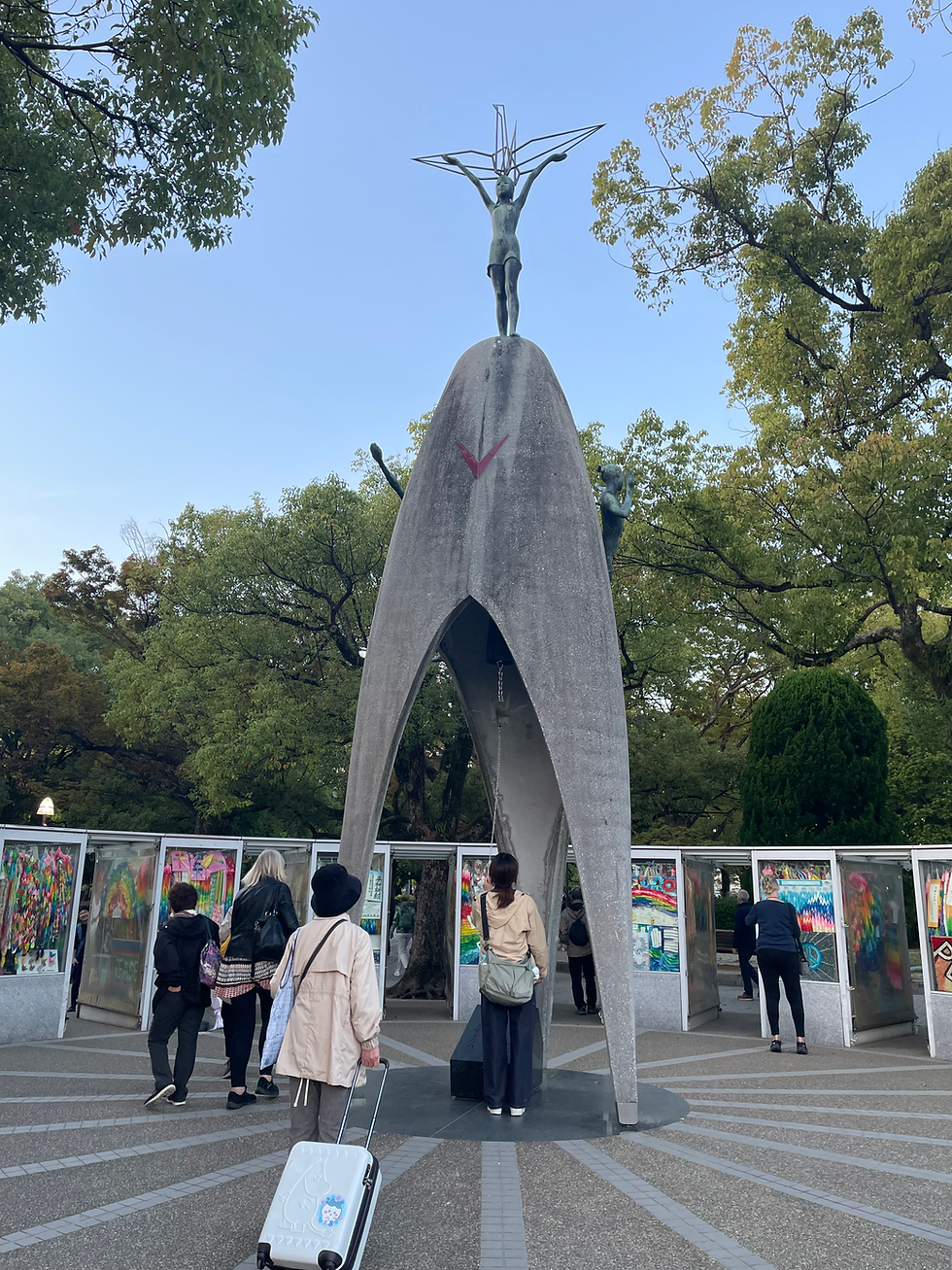
A short walk from the Dome to the Aioi Bridge over the Motoyasu River will take you to the other side of the Peace Memorial Park to the Children's Peace Monument.
This monument tells the heartbreaking story of Sadako Sasaki, a 12-year-old girl who was only two at the time of the bombing. She was perfectly healthy till age 11 when she developed leukaemia as a result of the radiation exposure. In 1955, she finally succumbed to the illness after months of fighting the disease.
The heartbreaking part of the story is that she kept making paper cranes till the very end, hoping that making them would grant her wish to live.
Visitors coming to the monument can make offerings of paper cranes. You can see hundreds of paper cranes and colourful origami floating around the monument, creating an emotionally poignant scene.
Cenotaph for the A-Bomb Victims and the Peace Flame
Very close to the Children's Peace Memorial is the Cenotaph, a concrete structure holding the names of all the known and unknown victims of the atomic bomb.
The arch shape of the memorial symbolises shelter for the souls of the victims.
Under the arch is the iconic Peace Flame that was first lit on August 1st, 1964, as a symbol of a world that is free from nuclear weapons. The flame has been kept alit ever since.

Hiroshima Peace Memorial Museum
A visit to Hiroshima Peace Memorial Museum is a trip down the darkest chapter of human history, as you see it gradually unfold, starting from the plight of the city that took the lethal hit, to the victims, and finally the perpetrators who engineered this dastardly act.
Here are a few things to be aware of before you visit the museum...
Opening hours for the museum and permanent exhibitions vary from month to month.
Please refer to the official website of the park (http://hpmmuseum.jp/?lang=eng) before your visit.
Massive crowds throng the museum, especially in the morning and late afternoon. To avoid long queues, it is advisable to make prior bookings, either through the official website or online platforms.
The ticket price is 200 yen for adults with discounts for students, seniors and group pass holders. Please refer to the website for more information.
The museum is massive. One should allocate at least 2 hours to see it, and add to it another 2 hours to see the Dome and the Memorial Park. This entire visit will take about 3 to 4 hours, depending on your level of interest, of course, to fully comprehend and appreciate the message it wishes to convey to the world.
As I've discussed earlier in this post, the museum can leave you harrowed, even grieving, after seeing the level of human suffering that people had to endure. The intensely emotional graphic images of pain can be very upsetting for young kids. The East Building of the museum has kid-friendly resources like media tables with child-friendly explanations of what happened in Hiroshima. If you're travelling with kids, you can explore this area.
The museum offers an immersive experience from one level to another. You will see pictures, war memorabilia and many audio-visual aids to navigate you through the history of WWII and the circumstances that led to the bombing of Hiroshima and Nagasaki.
Hiroshima can easily be done as a day trip from Osaka and Kyoto by taking the Shinkansen (bullet train). You can see the memorial park in the morning and visit the stunning Miyajima Island in the afternoon. We decided to stay overnight in Hiroshima and visit Miyajima early the next morning.
Hiroshima National Peace Memorial Hall for the Atomic Bomb Victims

Adjacent to the Cenotaph is the Hiroshima National Peace Memorial Hall for the Atomic Bomb Victims.
While the museum will give you the historical, geographical and political context of the bombing, the Memorial Hall is a contemplative space for understanding this incident in terms of personal human tragedies. You will see the Hall of Remembrance with 140,000 tiles with the names of people who died in the tragedy.
The Peace Memorial Park also has the famous dome with the Peace Bell, a Peace Clock, the Atomic Bomb Memorial Mound and the Korean Cenotaph.
We, like every other visitor, left the park with one overwhelming thought on our mind...Is this what one atomic bomb can do to a city and its people?...followed by the inevitable uneasy afterthought...now, every country on this planet has a nuclear arsenal far deadlier than this one, but have we, as humans, learnt any lessons from Hiroshima?
The next morning, we set out to see the stunning Miyajima Island, only 28 km away from Hiroshima...


Comments