
Kailash Mansarovar Yatra: A Journey to Mount Kailash

The Kailash Mansarovar Yatra is one of the most sacred pilgrimages in the world, and my journey to Mount Kailash remains one of the most transformative experiences of my life.
In this blog, I share a detailed account of this challenging journey, covering the route we took, the small towns we passed through on our way to Lake Mansarovar, the physical demands of the Parikrama, or circumambulation, around Mount Kailash, and what it truly feels like to witness this sacred mountain up close.
Om Namah Shivaya

A Journey to Lord Shiva's Abode: My Kailash Mansarovar Yatra
As I stand huddled with Gautam, my husband, at the staggering height of 5630 metres (Mount Everest is 8849 metres) above sea level on the Dolma La Pass in Tibet, with Mount Kailash in the background, to get a picture clicked for posterity, I feel numbness in my toes and elation in my heart.
This was the culmination of an arduous journey to Mount Kailash, considered the Axis Mundi or the celestial axis around which the cosmos rotates, a place where the physical and spiritual worlds meet on this earth.
It is the sacrosanct abode of Lord Shiva, the ‘Destroyer’ in the Hindu Trinity of Gods, Brahma, the Creator, Vishnu, the Preserver and Shiva, the Destroyer. It is believed that a pilgrimage to this holy land opens the doors of Moksha or eternal salvation and absolves the person of all his/her past life Karmas.
And here we were, my husband and I, standing on the glacier around the holy mountain, spellbound by both the creation and its creator.

Planning Our Kailash Mansarovar Yatra
The exciting journey to the revered Mount Kailash began from our domicile, Delhi, India. A small ad in the newspaper announcing the start of the Kailash-Mansarovar Yatra from India caught my attention. A discussion ensued about the level of fitness required to undertake such a formidable journey. One thing led to another, and we were perhaps destined to travel since everything just fell into place, the visas and the medical tests, et al.
Nestled deep inside the Trans-Himalayan region in the Tibet Autonomous Region of China, travelling to Kailash from India requires a multitude of official paperwork and formalities. An entry permit to China is procured collectively for groups of pilgrims from India.
The next thing I knew, we were filling out forms for the trip ahead with a local agent, 'Shrestha Holidays', who specialised in organising tours to Mount Kailash.
We booked an ‘All-flight’ route plan, a round air trip, which takes 12 days to complete and is considered to be the quickest since most of the trip is covered by helicopter. Land route, on the other hand, takes over a month to complete, is believed to be tedious, and roads are not your best friend in this part of the world.
These days, a lot of options are available for pilgrims, but back in 2012, one could travel to Kailash Mansarovar either with the tours organised by the Government of India that used the land route and lasted for about a month, or opt for private companies specialising in these tours, with options to travel by helicopter.
Journey to Tibet for the Kailash Mansarovar Yatra
There are many ways to reach Mount Kailash, and different tour organisers go with different routes, depending on the permits they have, the packages chosen by the pilgrims, the month of the year when the yatra begins, and, most importantly, the mode of travel.
Since we had opted for a 12-day ‘All-flight’ route plan, our journey started in Kathmandu...
Day 1 - Delhi to Kathmandu: Kailash Yatra Begins

We board a Kathmandu-bound aircraft, a regular-looking Boeing. At this point, little did we know the kind of small, dingy aeroplanes we would be boarding for travel in the days ahead!
We arrive in Kathmandu, and two people from 'Shrestha Holidays', our travel agent, are waiting to greet us at the airport.
Our hotel, 'Soaltee Crowne Plaza', is nice and welcoming. The rest of the day is lunch and rest.
Day 2 - Kathmandu to Nepalgunj by Air
The next morning, we meet the other group members, a motley group of 18 people, comprising a 12-member group of men only, another group of 3 siblings, accompanied by a Swami ji from Vrindavan and the two of us, Gautam and I.
Our first excursion comes in the form of a visit to the Pashupati Nath Temple.
From there, we proceed to our next destination - Nepalgunj.

Nepalgunj is a border town of Nepal with India. The airport is rather nondescript, and a coach drives us through a maze of dusty lanes and by lanes to reach Hotel Siddharth. The hotel is nothing much to talk home about, but the vibes within the group are certainly warmer by now. Over laughing and chatting, dinner is done.
Day 3 - Nepalgunj to Simikot by Air
We set out from the Nepalgunj hotel in a coach, from the airport by Sita Air to Simikot. The aircraft is a small 16-seater plane. We are 18, the obvious choice is Gautam and me flying in a separate plane. We happily relent.
The journey in this small plane lasts almost an hour. An hour of endless green hilly patches, of lush valleys, of snow peaks struggling to show up from behind these hills, and I, lapping it all up like an eager child in my camera.
With a sharp sweep, the plane turns a half circle and comes to a halt on a flimsy airstrip. The view outside is breathtaking. There is wind, and army men deployed in the area have heavy headgear, jackets and gloves, indicating the cold weather outside. We hurriedly put on the jackets we've kept handy and head out into the cold. The cool breeze has a rare fresh feel to it.
Simikot is a beautiful, sleepy village that was discovered as a potential route to Mansarovar not so very long ago. So the only connection it has with the outside world is by air. No roads, not even broken dusty zig-zag paths, connect it to any place known.
So here we are, cut off literally from everything we know as ours.

We collect our belongings and head up the staircase. Our bags are collected by local women, and we trudge forward onto an uphill trek. After around 20-25 minutes of walking, we reach a camping lodge called 'Sun Valley Resort'.
We go looking for our rooms. One look at the room, and I remind myself that we are on a pilgrimage. No beds, no heating, no attached toilets and no TV. We share a big room with the 3 siblings, Swami ji and a sanayasin from the USA. All seven people lay out on mattresses on the floor.


In the evening, we meet a group of pilgrims who had just returned from Mansarovar. We are all ears as they narrate their experiences. One of them, a doctor by profession, decides to do a physical examination for all of us. We are all running high BP. This he attributes to the altitude.
Little does he know that it's not the altitude, but the stress of going into the unknown terrain, fuelled by the not-so-exciting narratives by his group members of the harsh conditions prevalent at Mansarovar. We learn that Mount Kailash is experiencing heavy snowfall with temperatures well below zero, and Lake Mansarovar is also extremely cold. And we have plans to take a dip in this icy lake...please check my BP!!!
Day 4 - Simikot to Hilsa by Helicopter
We set out to face another day...a short trek down the hill from the resort and back to the airstrip for our onward journey to Hilsa by Helicopter.
Simikot to Hilsa can easily be rated as the longest helicopter ride known to mankind. Not because it lasts a good 35 minutes, but because of the scenery that shifts within such a short span. Simikot is all lush green, but a change in the gear of the helicopter takes you suddenly to an arid, cold desert in no time.

The terrain turns deep brown with dry mountain sides and scanty vegetation. I am craning my neck to catch a glimpse of the scenery below. The helicopter lands amidst a cloud of dry dust picked up from the mountainside as we clamber down the steps of the helicopter while trying all the time to see through this haze.

Hilsa is a small village, not a village, a small cluster of houses haphazardly thrown together that lie in complete ruins because of abject poverty at the tail end of Nepal. Its only claim to fame is its location en route to Kailash.
We walk towards the village, chugging along with our bags. We can feel the roughness of the weather in this thin mountain air. As we approach the village, the local folks' eyes follow us. We are supposed to gather in a small mud house and wait for further orders. The woman offers us tea, and we quickly take out the small titbits that we are carrying to eat.
The day is sunny but cold. The thirty-minute planned halt turns into a good two-hour wait, hot tea being the only consolation. After some pictures of the ruins and a goodbye to the locals, we head towards the bridge over the River Karnali, which is our passage into China. The bridge is rickety and starts rocking as we step on it. Nonetheless, it lands us safely across the stream onto Chinese territory.
Reaching Lake Mansarovar
We see Land Cruisers lined up on the roadside. No sooner do we reach the spot than we see Chinese visa officers with our passports in their hands waiting for us. We take turns to get our credentials checked. The officer makes every pilgrim remove his/her head scarf to verify their identity.
We settle in our cars, relieved of the deafening wind and biting cold, and start the journey on this scenic, serpentine route, obstructed only twice by the two Chinese checkpoints that stop our convoy for a more-than-thorough check. So thorough that the pictures in the camera are also rewound and screened. Trust the Chinese with anything less than that! We had been hearing stories about the rigorous security checks that are carried out at Chinese checkpoints by returning fellow pilgrims.
Our destination is Taklakot, also known as Burang, a Chinese border town that will work as our acclimatisation hub both on the onward and return journey. Another check post, and we enter the town. The hotel has a Chinese name to it, so we don’t bother much about it. Our concern at the moment is to get used to the cold and get some rest if possible. A nice warm lunch awaits us. The Tibetan sherpas are extremely good cooks and caretakers.

Towards evening, we venture into the local market picking up stuff like torches, gloves, jackets, caps, etc. And yes…nose caps. We have been told to keep our noses covered when venturing out; otherwise, one could bleed from the nose. Somehow, nothing feels adequate for this cold. Cold that seeps through one’s bones and into the blood. I start wondering what Mount Kailash would be like...

I cannot proceed with this memoir without narrating this foolhardy adventure by my husband and me. We were told that this hotel in Taklakot is the last proper accommodation in the days to come, so, just before going to bed, we decided to take a bath. We take turns to have an elaborate hot water bath. No sooner do we finish with the chore than we start shivering like a leaf.
To our horror, we discover a placard on the back of the door stating: ‘No shower within 12 hours of arrival’. Interestingly, other people in the group also ignored the instruction. So, together we shivered. Late evening, we are visited by two doctors, both natives of Nepal, who reprimand us for our indiscretion and then check on our general health and fitness for the next day.
Day 5 - Destination Mansarovar
Gautam and I are accompanied by these two Nepalese doctors in our car. We couldn’t have asked for more. The doctors chat nineteen-to-a-dozen, and our insatiable curiosity for this unknown land is at its peak. The doctors tell us stories of the Chinese invasion of Tibet, how the Tibetans have been living in caves even in this day and time and the folklore surrounding this strange land.
Calling this landscape just scenic would be an understatement. It's enchanting and mesmerising. The beauty of this nothingness cannot be expressed in words. Our first introduction to this land of snow is in the form of the Guru Mandala Mountain. They are an important pilgrimage for the Tibetan people.
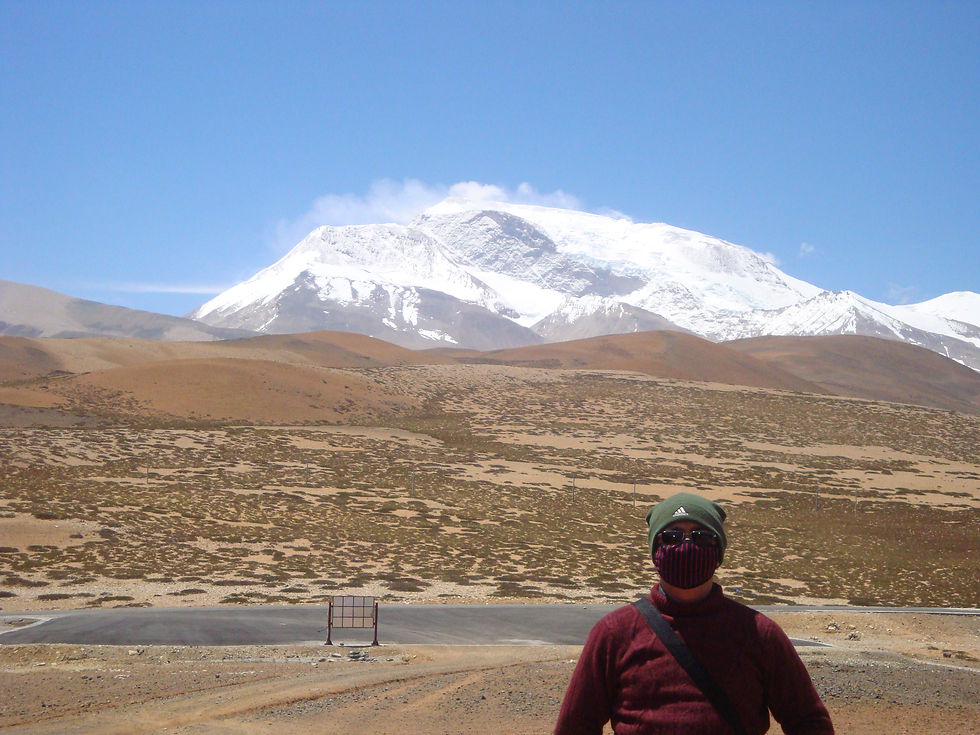
Our first short halt is 'Rakshas Taal'. The clear waters of the salt lake are a placid blue. So blue that it makes one wonder if it's for real. The legend has it that Ravan, the Rakshasa King, worshipped Lord Shiva after taking a dip in this holy lake.


When Lord Shiva appears, Ravan asks for a boon. He asks Shiva to turn the water of this lake into poison so that no one can take a bath again in this lake to appease Shiva. Lord Shiva relents, and so it is forbidden to touch the water of this condemned lake. But around the lake, Tibetan signs of worship are aplenty in the form of animal horns, stone pieces bound together by pieces of colourful cloth.
The fervour of watching this deep blue lake is barely settled, and behold! The tip of Kailash is peering out of the mountains in the distance, and our cameras go into a frenzy....

We move on, the road entwines again and yet again, and our car pulls up into a small courtyard surrounded by small houses made of mud. So, these are the mud houses we've been hearing about!!

A series of small cottages joined together with a narrow verandah in the front. I am not disappointed. The place looks clean and habitable, barring the toilet, which is almost 100 feet away. What if I have to cover these 100 feet in this biting cold in the dead of the night?
My thoughts are interrupted by the light blue water body in the vicinity. The Holy Lake Mansarovar. A body of pale blue water. So tranquil and so sublime. We are transfixed.
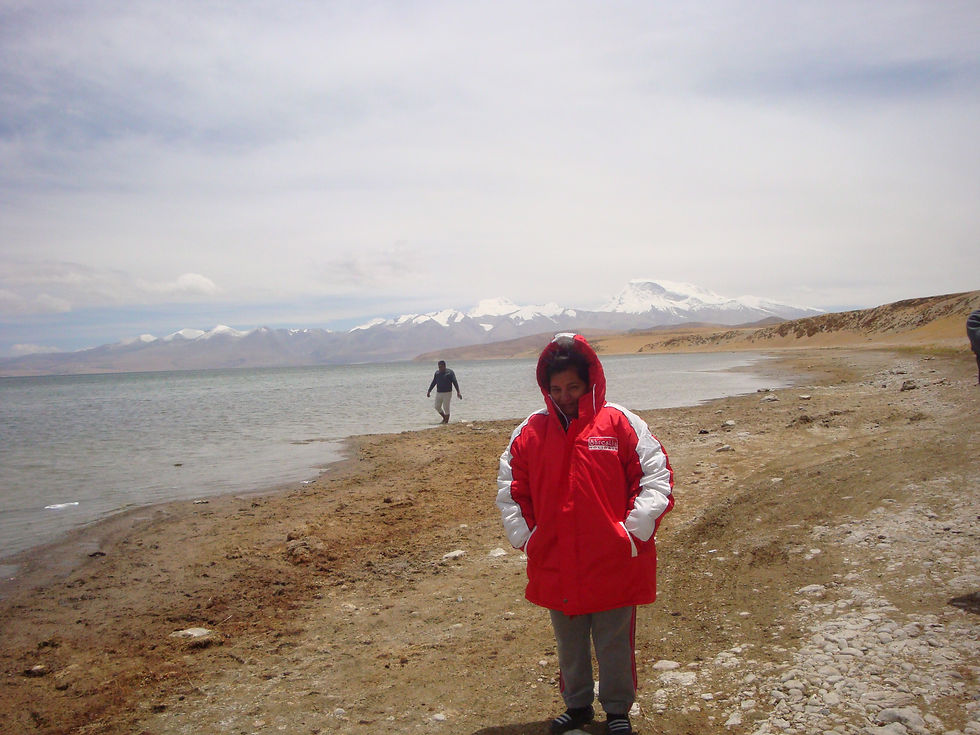
We prepare for the dip in the holy water, followed by Puja and Havan at the edge of the lake. We are wearing layers of clothing, the last layer being the one meant for the proverbial dip.
A small make-shift tent is erected by the sherpas for us, the three women in the group, as a changing shelter, but the wind decides to rip it away. But we have more pressing things to worry about, like taking a dip in the icy cold water of Lake Mansarovar. Will it actually lead me to salvation?? My mind goes blank as I brace myself for the dip. The touch of molten ice against the skin cuts into my flesh, one, two, three .... and seven ...I've done it. Seven dips, one for each family member and still breathing...God alone knows what humans are capable of! We use our car as our changing shelter at last.

The scene is set for an elaborate Puja. Both groups are carrying every possible ingredient required, a silver snake, a small silver trident, silver coins, flowers, sweets, holy thread, vermilion, a silver plate and spoon and also a beautiful glass Shivling. After immersing the silverware and coins in the lake, we move to a secluded spot in the hill on the side away from the wind for the havan. Amidst chanting of mantras, the fire is lit with great difficulty, with the wind playing spoilsport. And the havan is concluded with the distribution of the prasad.

This puja has left our bodies and souls all warmed up. With an inexpressible sense of calm, we head back to the mud house. Step one is done. Well done!
We are welcomed by a hot cup of tea on arrival, and preparations for the next day get underway. A Russian group comprising almost a 100 mountaineers has just returned from the Parikrama of the Kailash and is gushing with enthusiasm about the trip. Their enthusiasm is infectious. We all gather around to hear their tale of glory. They casually tell us how they sat on the mountain slope and sledged their way back. My heart is pounding, trying to visualise myself sitting on a hilly slope and sliding downhill. God help us!
According to popular belief, Lord Shiva and Goddess Parvati come for a dip in the holy lake each morning just before dawn (Brahma Mahurat). We overhear people wanting to go and sit by the lakeside to watch the spectacle. In the wee hours of the morning, our eyes shimmering with hope, we set forth to the lakeside to see gods manifest themselves as stars and take a dip in the holy water.
Six of us head out in the dusky, cold morning, spread out a blanket to serve as a mattress on the side of the lake, huddle close to each other and gaze in anticipation at the lake. The thin, cold air is numbing our bodies, but is overshadowed by the magnetism of God’s creation around us. It’s finally morning, 4:30 am Indian time. I cannot claim to have witnessed any magical spectacle, but the experience is worth its while. The serenity of the morning, the sound of water rustling and the stars in the sky above shining as diamonds...priceless. I'll remember this stargazing for years to come.
Beginning the Parikrama Around Mount Kailash
Day 6 - Parikrama of Mount Kailash Begins Today
After an overnight stay at a mud house near Lake Mansarovar, we head to Darchen early the next morning, our last destination on the motorable road. An unassuming Tibetan-style monument held in great reverence by pilgrims, called Yama-Dwar, literally meaning ‘Gateway to the Kingdom of Death’, greets us. The monument symbolises the end of all worldly attachments.
Most pilgrims pay their obeisance to Lord Shiva at Yama-Dwar and head back.
Pilgrims who aspire to do the circum-ambulation or Kora of Mount Kailash literally walk over to the other side of the Yama-Dwar to start the Kora. As per the Hindu and Tibetan beliefs, doing the Kora of Mount Kailash grants the person Moksha or eternal salvation.
Only ten people out of a group of eighteen opt for the journey ahead, one had dropped out as early as Simikot, scared by the first-hand accounts of pilgrims just returned. Seven will return from Mansarovar itself.


The challenging part of the pilgrimage starts from Yama Dwar, that of doing the circum-ambulation, ‘Kora’ as it’s called, of Mount Kailash.
There are 2 overnight camps during Kora, one in Diraphuk and the second in Zuthulphuk.
‘Kora’ lasts 3 days, covers a stretch of 52 kilometres around the mountain and can be done either on foot or on horseback. It is not for the faint-hearted, we’ve been told. Walking uphill in the thin mountain air can be strenuous.
On the other hand, sitting perched on a pony over a treacherous mountain trek where the slightest misstep could plunge a person into a bottomless gorge is equally scary.
We are perhaps destined to go ahead. Our ponies are ready; they allocate ponies by picking chits. I am assigned a young, beautiful mountain girl as my pony driver and the head sherpa, 'Uttam', as the porter. Gautam gets a young sporty lad as his pony driver.
It's 11 am. The trek starts, and the beauty of the mountain starts unfolding gradually in front of our eyes. There are streams and brooks with crystal clear water, mountains and hills with some green patches and more brown ones; the sky is glistening with sunshine, not a speck of cloud today. This should be easy.
I ease into the pony and start enjoying the uphill trek. We stop for a short break en route, take pictures and resume the journey.


At about 3:00 pm, we arrive at Diraphuk, the first overnight camp. We share a room facing Kailash with two more people from the group. Mount Kailash is right outside our window, far away, but clearly visible. I can see it with my head on the pillow. What surprises me is that the proximity to Kailash is actually unnerving me. Kailash is shining like a gem in the ocean of darkness around us, and the silvery sheen can play on one's senses.
In retrospect, I feel that I should've at least taken some pictures of what I saw in those moments, but altitude sickness, a distant reality till now, comes in full force over me. I feel fatigued, dazed, and lost. I get up feeling nauseated and breathless and have to take an oxygen shot. We abstain from using the toilets outside. The two doctors had warned us about the wild mountain dogs, which can rip a human apart since they have tasted human flesh, owing to the Tibetan ritual of leaving their dead out in the open for the dogs to devour.
I am happy to see dawn breaking. Camp night one is over.
Crossing Dolma La Pass - The Toughest Part of the Kailash Yatra
Day 7 - Day Two of the Parikrama around Mount Kailash
8:00 am on the 9th of June, 2012, we set out again. The second day of the parikrama is believed to be the toughest, and my stomach is in knots.
We have been hearing scary accounts of pilgrims not being able to cross the glacier or who fainted because of breathlessness. Hot tea is served, followed by a steaming hot breakfast. The food is always well-cooked, but we hardly do it justice due to our lack of appetite.
We walk for 15-20 minutes from the Diraphuk Camp, cross a wooden bridge, climb up a small hill and see ponies waiting for us at the foothill of a mountain. I sit up on the pony and brace myself for the day ahead.
In the far distance, I can see ponies and pilgrims walking up a mountainside so steep that it would put an inclined plane to shame. I quickly grab my pony and sit tight on it.
The trek starts. We cross plains, hills, zigzag paths, all leading to that same mountainside. Specks of snow start becoming visible on the sides of the path, and the air gets thinner and colder. Instinctively, I pull my jacket closer and adjust my cap.
After about two hours of the trek, we are asked to get off our ponies; we have reached the highest point of the journey, the Dolma La Pass and the uphill trek has to be done on foot.

This pass is at a staggering height of 19500 feet above sea level and every bit cold. My husband is a little ahead of me and makes a gesture with his hands, asking me to get down from my pony now. I see him, but barely respond. Where are we? What place is this? I am in a trance. Still looking around, I get down from the pony. He pulls me close, I can feel my eyes moistening, we pose for some quick photos, look around, take in the enchanting scenery, hold hands and look with awe at the shining mammoths of snow all around us.
I remember trying to inscribe the scenery in my mind. On our right is a steep gorge leading to the snow-filled valley called 'Gauri Kund', the mythological frozen lake, and bathing pond of Goddess Parvati, Shiva’s consort and Mother Goddess.


We've been told not to spend more than 2 to 3 minutes at the peak, the lack of oxygen can play havoc with your reflexes and can throw you into unconsciousness. But we stay still as moments pass, trying to look around us, inscribing the scenery on our minds, on our souls, after all, it had taken us a good 7 days to reach here.
There is nothing to see, and yet the beauty of this nothingness cannot be described in words. I am reminded of the memory game that we used to play as kids, where you are made to see so many objects all together, and you try to memorise them. How will I remember these beautiful hills that were half white and half brown? Or the narrow path that was showing out of the snow because a jet of water was pushing its way through it? Or the adjacent hills separated by a wide snow-covered valley, that seemed so close that one could touch them with bare hands and feel the cold snow underneath. Gautam can see that I am lost, numb and cold. He holds my hand, and we set forth.
The other side of the mountain is steep downhill all the way, but there is no time to think. My porter nudges me to move on; he knows the pitfalls of staying too long at this height. We start walking, my husband close on my heels. The rarefied air, the coldness gripping my feet and the strange magnetism of this place leave me breathless. Literally, in fact. Suddenly, I feel a constriction in my chest. I can barely breathe. In no time, I am panting for breath. Both Gautam and the porter run to my rescue with the oxygen cylinder in their hands. I grip the cylinder and inhale forcedly. There is a gush of cold air in my lungs, and now I feel the dizziness passing away. Our feet are so cold that they have lost all sensation. The porter grabs my arm, and we start descending the mountain. The ground beneath my feet is slippery with the snow. We walk one behind the other on that narrow path, quietly aware of the beauty around us, hoping that the towering peaks would bear witness to our presence here.
After dragging our feet along on this rocky, snow-laden path for a good 5 kms, we reach a point where I can see ponies waiting for us again. The sight is welcoming, but I am too exhausted to express it. The porters take a short snack break and happily munch on the packed lunch that we are all carrying. The sight of them eating makes me sick. I know I am hit by altitude sickness.
The Last Step Before the Kailash Mansarovar Yatra Ends
We get on our respective ponies to cover the remaining 10 kms that is left of this days' journey. Now we are on a slightly flattened plain, the evening sun is mild and rosy, and everyone looks more relaxed in the knowledge that the ordeal is over. I keep thinking of taking out my camera and taking pictures of this scenic trek, but I am simply too tired to do it. In about 2.5 hours, we reach our second camping point, Zuthulphuk.

Day 8 - Last Day of the Parikrama around Mount Kailash
I get up feeling ecstatic despite the exhaustion. Have we really crossed the Dolma La Pass?
We set out on the final trail. The ponies take us down only till a certain point; thereon, we have to walk. A welcome walk, nice sun, warm day, our minds relieved of the stress of the earlier two days,
Lake Mansarovar is far yet easily visible, and the knowledge that a car will be waiting for us at Darchen sounds thrilling, no less. It's a perfect setting except for this 3-kilogram jacket that was provided to us by our travel agent. I am grateful for it, with all my heart, but I'm also desperate to return it to wherever it came from.


The scenery is like nothing we've ever seen before. The mountains are all different hues of blue, brown, purple and green. We spot a beautiful emerald green stone resembling a 'Shivling'. I pocket it as a prized divine souvenir. We walk along the river, and before we realize we spot the 2 Land Cruisers. We say goodbye to the local guide, settle ourselves in the car, and I say a silent prayer. Unlike the Russian mountaineers, we did not have to sledge down the mountain. The sunny weather without a speck of cloud in the sky for the entire length of the journey made our descent rather easy.
All pilgrims, after completing the Kora of Mount Kailash, do the Lake Mansarovar parikrama on the way back. This is done by car and takes around 2.5 hours to complete since the circumference of the lake is a good 88 kms.
I am itching to take a good shot of the Kailash mountain. Namgel, our guide who is escorting us, assures me that we will get this opportunity soon. I can hardly wait, we halt, take pictures, get back into the car, and head further for a short puja again. We halt again. Namgel was right. This is perhaps the point that we have seen in all posters and pictures of Kailash Mansarovar. The Kailash juts out imposingly from behind the bluish waters of the lake. Enchanting!!

To my utter disbelief, I realise that our group members plan to take another plunge in the lake. My husband and I plan to consult Swamiji on the matter. Swamiji is a rational man; he feels we may or may not take a dip again, depending on how we feel about it. We quickly opt for the latter before Swamiji changes his mind.
We do a 'Panchsnan', a 5-part washing ritual, implying washing only the two hands, two feet and the face. Once again, we approach the icy waters of the lake, cleanse ourselves and fill up the bottles that we have with this holy water. I have many requests from people to fetch this holy water for them.
We sit in a half circle for the puja and go over the rituals, but my eyes wander again and again to the majestic Mount Kailash in front of us. I could look at it forever. The single-block mountain covered with pristine white snow has a hallucinating effect on the mind. Reluctantly, I pull my gaze away and try to concentrate on the rituals.
We are done with the puja, take more pictures and complete the parikrama.
Day 9 - Overnight Stay in Taklakot on our way back from Kailash Yatra
We reach Taklakot in the afternoon by road, take a hot water shower after having spent three arduous days in the sun, and go to bed feeling rejuvenated like never before.
In the morning, we are back at Hilsa, followed by the helicopter to Simikot.
Day 10 - Overnight Stay in Nepalgunj on our way back from Kailash Yatra
From Simikot, we take a plane back to Nepalgunj. I am missing the fun we all had together on our onward journey. Now it's quieter as we go about the business of getting back. We reach a very hot Nepalgunj at 46 degrees Celsius.
I thought the excitement of the journey was over, but to my surprise, there's more to come. In the evening, we bump into another group of pilgrims bound for Kailash Yatra at the hotel in Nepalgunj. The moment they come to know that we did the Kora, the whole bandwagon lands at our hotel room. The questions are endless, just as we had on our way up.
Day 11 - From Nepalgunj to Kathmandu by air. Overnight in Kathmandu on our way back from Kailash Yatra
Our group members have dispersed; everyone is headed to their respective domiciles. A sumptuous lunch awaits us in Kathmandu at the hotel. I'm happy to not puke at the sight of food.

Day 12 - Kathmandu to Delhi by air, the last leg of our Kailash Yatra
The journey to the revered Mount Kailash had ended, but the nostalgia had yet to begin. I jotted every detail of this journey in my diary on our way back. This account is an extension of those notes.
Tips for Kailash Mansarovar Yatra (From Our Experience)
The journey to Mount Kailash and Lake Mansarovar is one of the most formidable journeys, with challenges like
Extremely tough terrain, which can induce altitude sickness
If you plan to do the Parikrama, be prepared to walk for long, treacherous stretches, even if you hire a pony. There are segments where you will have to get off the pony.
Unpredictable weather conditions
Lack of modern infrastructure, like basic toilets and accommodation, especially at Lake Mansarovar and during Parikrama
No outside medical help available except the one you have with your travel operator
Can be more challenging for people with medical conditions like hypertension, asthma and knee-ailments
No phone connectivity during the 3-day Parikrama
Here are some practical tips and insights that we compiled from our experience. It's important to plan your trip well ahead and be prepared for contingencies, if any.
First of all, identify how you wish to travel, by road or by air. A road trip can be more strenuous and time-consuming. The air trip is shorter but almost 3 times more expensive. We undertook this journey in 2012. The prices would've been revised over the course of time, but to give you a vague idea, we paid about 1.5 lakhs per head for this entire journey, 14 years ago, with a private travel agent.
It's also important to decide whether you wish to do the Parikrama or not, because that is the most difficult part of the journey. If you wish to do it, then you should be medically fit, and you need to start preparing for it months in advance.
This would include cardio training to increase stamina, undertake lunges and squats to increase circulation and strength in legs, do knee-strengthening exercises, and do breathing exercises like Pranayam to increase lung capacity.
Doing the parikrama is a double-edged sword. If you do it on foot, then it requires a lot of stamina since you will have to walk 52 kilometres in extreme cold. If you opt for a pony, then sitting on horseback for 3 straight days can also be very challenging.
Apart from physical fitness, a lot of mental preparation is also a prerequisite to complete this tough journey. One needs to be prepared for challenging weather conditions, namely extreme cold, blizzards, rainfall, extremely chilly winds, and if it's not raining, then be prepared to endure the unfiltered rays of the sun. The very steep uphill trek, 3 or 4 days of survival in very limited comforts, like open toilets and basic accommodation facilities, will also test your grit and mental strength.
A proper medical exam is a prerequisite to proceeding on this arduous journey. Your medical examiner should certify that you are physically fit and capable of undertaking this journey. Your organisers, whether state-run or private, will ensure that you fulfil all the medical fitness criteria. You must disclose any medical condition, like Asthma or hypertension, that could prove to be dangerous, even fatal, in such high altitudes. Remember, the problems related to high altitude are very real, and they can play havoc with your breathing.
Packing judiciously for your journey ahead is very important. There is an upper limit to the amount of weight one can carry, depending on the package you've opted for. Normally, organisers provide you with a rucksack and a list of things that you need to pack. It's important not to deviate from that list. Carrying a pair of waterproof trousers and a jacket is a must. The organisers will provide you with a jacket that you are required to wear during the parikrama. Each item of clothing is securely put in plastic stick-on bags, in case there is any rain or snow.
You should also pack high-energy snacks like protein bars and dry fruits for the duration of the Parikrama.
Was the Kailash Mansarovar Yatra worth it?
In the days that followed our return from the Kailash Mansarovar Yatra, many of our friends and family wanted to know how we’d felt being in such proximity to something we hold so sacred, so divine. Was the journey worth all the effort we'd put in?
Worth is allocated to things that can be counted, calculated, described, valued...
How can I assign value to the inexplicable bliss I felt while standing on the highest point of the glacier on Dolma La Pass?
How can I assign value to the humility I felt upon the realisation of our insignificance in the larger scheme of things, which are totally beyond our knowledge and comprehension?
How can I assign value to the happiness I felt, that all the comforts of the world put together cannot buy?
How can I assign value to the pride I felt, that I could utterly disregard the needs of my physical body and still live to tell my story (remember the 7 holy dips in Lake Mansarovar in icy cold water)
This journey exposed a part of me that I was unaware of; it took me on a journey inward, into the unexplored consciousness of my mind that would have always remained dormant and would have been silenced in the humdrum of life.
If this realisation is not a worthy cause, then what is?
Om Namah Shivaya!


Comments