
Ho Chi Minh Mausoleum, Hanoi

Updated: May 9
The Ho Chi Minh Mausoleum in Hanoi is the final resting place of President Hồ Chí Minh, a revered Vietnamese leader and revolutionary, affectionately known as Uncle Ho. He was the first president of the Democratic Republic of Vietnam.
As a tourist, you might wonder what could be so special about a mausoleum. But a visit to this mausoleum could turn out to be a memorable part of your Hanoi trip, let me tell you why...
The mausoleum is located in the heart of Hanoi in Ba Dinh Square, a renowned landmark in Vietnam with significant historical significance. This is the place where Ho Chi Minh read the Proclamation of Independence of the Democratic Republic of Vietnam on September 2, 1945. The square features many important buildings, including the Presidential Palace and the National Assembly.
We reached there and were taken aback to see such massive queues starting at the entrance itself. The mood is celebratory as tourists, both domestic and international, flock to the venue early in the morning to pay their respects to Vietnam's revered leader.
I'm not exaggerating when I say that at least a few thousand people were waiting to enter. It felt as if we'd have to spend an entire day at the mausoleum. But the moment we stepped into the queue, we knew this was going to be a different kind of experience.
We saw soldiers and guards stationed along the entire length of the long covered maze of corridors that run around the mausoleum. The corridors run past the Ho Chi Minh Museum and the famous Ba Dinh Square, and the exquisitely manicured green spaces. This entire exercise was done seamlessly without any fuss under the strict watchful eyes of the guards on duty.
As we approached the mausoleum, the atmosphere became solemn. Photography inside the mausoleum is strictly prohibited.
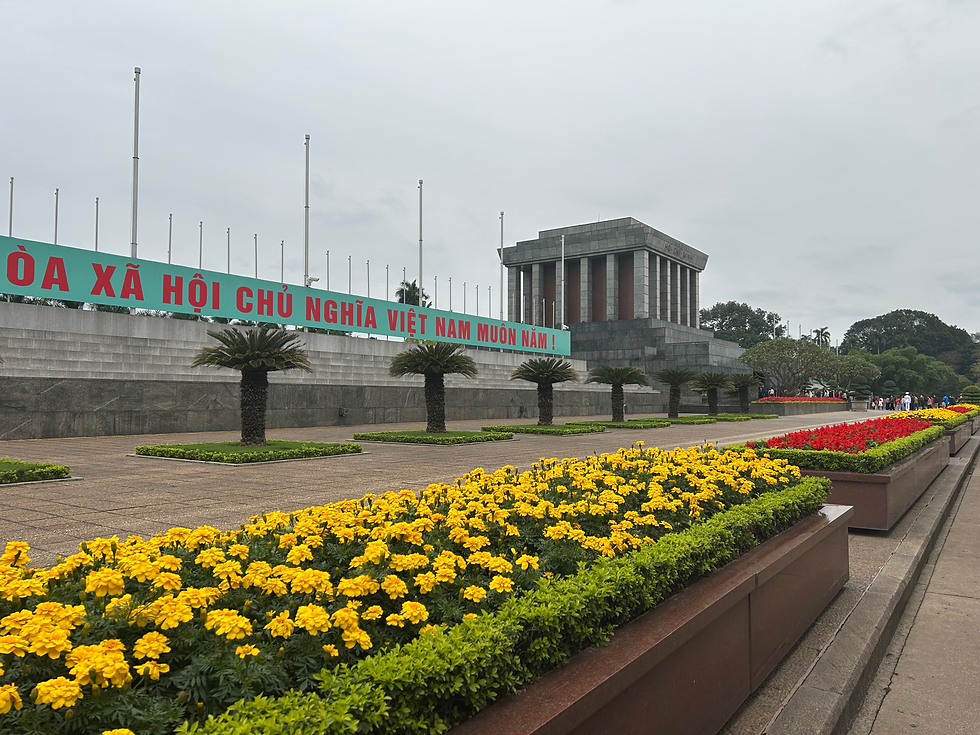

The embalmed body of President Ho Chi Minh is preserved in a glass sarcophagus, kept elevated on a massive stone plinth, and visitors go around the plinth in a semicircle to pay their respects. The visit inside the mausoleum barely lasts a couple of minutes since no one is allowed to stop or slow the queue down.
What stayed with us after the visit was not just the impressive infrastructure, the modern design of the monument with traditional Vietnamese elements, but the unmistakable air of reverence and discipline with which this tour is conducted, reflecting the deep love and respect the Vietnamese people have for their beloved leader.
Things to know about visiting the Ho Chi Minh Mausoleum in Hanoi
Don't get deterred by the massive queues. You'll be in and out in less than an hour, as I've mentioned above. The trick is to reach as early as possible in the morning.
Entry to the mausoleum is free, and the last free entry is at 10:15 am. After that, entry to the mausoleum is closed. You can still enter the premises to see the Presidential Palace gardens for a ticket and walk around Ba Dinh Square.
The most important thing to remember is that the embalmed body of the president is sent for re-balming, and during that time, the mausoleum remains closed. Kindly check the official website before your visit.
The mausoleum is located about 3 km from the Old Quarter, and you can easily walk to it. You will find a lot of rickshaw pullers in the Old Quarter who will entice you to get on their rickshaws. Please ensure that you fix the fare amount in advance. We hired one such rickshaw and paid in VND at the end of the ride, only to realise that what we paid converted to roughly 10 USD, which is a lot for such a short ride.
A very strict decorum and code of conduct are followed inside the premises. Caps, hats, shorts, exposed shoulders and knees are not allowed. You can carry a small handbag, though, and mobile phones are allowed.
After leaving the Mausoleum, you can see the Ba Dinh Square, where there is a flag hoisting ceremony that takes place every day at 6:00 am. Timings can vary depending on the season.
Very close to the Square is the famous Presidential Palace. This beautiful, bright yellow building was the first official residence of Ho Chi Minh. Now, it's used for political gatherings and official functions. There is a ticket counter right outside the square.
You can buy tickets to see the beautifully landscaped gardens around the palace, a serene water body and the famous stilt house that President Ho Chi Minh used as his office. The entire area offers insight into his simple and dedicated lifestyle.


Very close to Ba Dinh Square is the Ho Chi Minh Museum.

As the name suggests, the museum is dedicated to the life of Ho Chi Minh. It is one of the largest museums in Vietnam, spread over 18,000 square metres.
Entry ticket costs VND 40,000 for foreign nationals. The museum has 3 storeys with a wide range of artefacts and documents showing the early life of Ho Chi Minh and his rise as the prominent leader of Vietnam.
About 350 metres from Ba Dinh Square is one of the most famous Buddhist temples in Vietnam, called the One Pillar Pagoda.
One Pillar Pagoda is an important historical landmark that lies barely 300 meters from the Mausoleum. Built in the 11th century, the pagoda is called Nhat Tru Thap in Vietnamese which roughly translates to happiness and prosperity.
The pagoda is designed as a giant lotus flower and is placed in the centre of a lotus pond.

My Tip -
The pagoda is beautiful and offers a very serene and calm atmosphere. There are lots of benches under the shade to sit around the pagoda in case you wish to relax after the hectic activity of the mausoleum in the morning.
As a mark of respect, one should be very modestly dressed, with covered knees and shoulders, to see the pagoda from the inside.
The entry fee is included in the ticket you purchase for visiting the Presidential Palace and gardens.


Comments